Myocardial revascularization with endarterectomy in a patient with recurrent restenosis and a probable autoimmune inflammatory substrate.
Article Sidebar
Main Article Content
Abstract
Introduction: Multivessel in-stent restenosis represents a complex therapeutic challenge in ischemic heart disease. Despite advances in drug-eluting stents, neointimal hyperplasia and persistent vascular inflammation continue to drive progressive reocclusion. When diffuse lesions involve previously stented segments, coronary artery bypass grafting combined with coronary endarterectomy emerges as an effective salvage strategy.
Case Report: A 44-year-old female with a history of hypertension, type 2 diabetes mellitus, and severe preeclampsia presented with recurrent acute coronary syndromes between 2023 and 2024. She underwent six percutaneous coronary interventions with multiple stents placed in the left anterior descending, circumflex, and right coronary arteries, uniformly progressing to severe recurrent restenosis. She was readmitted with progressive exertional angina and rest pain. Left heart catheterization revealed 100% occlusive restenosis of the right coronary, circumflex, and marginal branches, alongside a critical 99% ostial restenosis of the left anterior descending artery. Laboratory workup demonstrated positive antinuclear antibodies, ferritin >1000 ng/mL, and elevated C-reactive protein, suggesting an underlying autoimmune-inflammatory substrate.
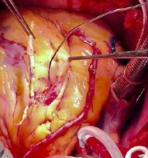
Case Evolution: Given repeated percutaneous failure and diffuse luminal disease, myocardial revascularization with four bypass grafts was performed, incorporating coronary endarterectomy and surgical stent extraction from the left anterior descending artery to restore the distal vascular bed. The postoperative course was uneventful, achieving hemodynamic stability, clinical symptom resolution, and preserved ventricular function.
Conclusions: An underlying inflammatory-autoimmune etiology can act as a primary driver of refractory multivessel restenosis beyond traditional cardiovascular risk factors. In patients with diffuse coronary disease and recurrent percutaneous failure, surgical revascularization coupled with endarterectomy and stent extraction provides a durable therapeutic alternative, underscoring the necessity of comprehensive immunological evaluation.
Downloads
Article Details

This work is licensed under a Creative Commons Attribution-NonCommercial-ShareAlike 4.0 International License.